A dreaded but essential exercise, feedback is often as feared by the person receiving it as by the person giving it. Yet it is a remarkable tool for fostering growth in a professional setting.
We focus here on the art of GIVING feedback, and on the most common mistakes we observe in this sometimes neglected process.

Whether it is "positive" or "corrective", let us remember that the goal of feedback should always be to obtain the right behaviour in the future — whether it concerns an attitude or a working method.
Mistake #1: Confusing positive feedback with praise
If you think you gave feedback recently because you said "Well done" to a colleague, that is not the case. Praise lets the person feel good in the moment, but does not tell them what to repeat in order to keep doing well. Positive feedback, on the other hand, is far more precise: it pinpoints the behaviour that led to success and thereby hands over every key to doing just as well in the future.
Mistake #2: Confusing corrective feedback with punishment
Conversely, it is utterly counterproductive to see corrective feedback as a punishment. Why? Because while feedback aims to obtain the right behaviour in the future, punishment focuses on a past event. All that punishment creates in the future is fear and avoidance. Indeed, the next time the situation arises, the punished employee will tend to conceal their mistakes for fear of further punishment, thereby creating new problems.
Mistake #3: Giving only corrective feedback
Some people never take the time to highlight good behaviour, and tend to see only what is wrong. It is in fact more productive to give more positive feedback than corrective feedback, for two reasons. First, credibility: your corrective feedback will be heard and heeded more readily if you also know how to point out what is going well. The second reason is more subtle: by giving proportionally more positive feedback, you help to de-stigmatise the practice of feedback in the eyes of the team. People then start to perceive feedback as a moment that is more often pleasant than unpleasant, and become naturally more receptive to it.
Mistake #4: Waiting for a formal meeting to give feedback
This is probably the most common trap managers fall into: waiting for the annual or semi-annual review to offer feedback to team members. Yet every day that passes without seizing the opportunity to give feedback is time lost for reinforcing or correcting a good or bad behaviour, and therefore a missed opportunity to be more productive, individually and collectively.
Mistake #5: Putting feedback off until later
The longer you wait to give feedback, the more likely a bad behaviour will turn into a bad habit — and we all know how hard it is to change a bad habit. By favouring frequent feedback on small things, it is easier to help people stay on the right track.
Mistake #6: Not preparing your feedback
Good feedback is not improvised. It is crucial to take the time to prepare it, all the more so if it is corrective feedback on a delicate point. The good news is that in just a few minutes, by following a simple four-step model, you can transform any difficult conversation.
Mistake #7: Giving feedback in writing
Giving feedback is not always an easy exercise, so it can be tempting to deliver it in writing to control the content and better manage your emotions. But this is not the most effective approach, because writing leaves room for interpretation of your intent. Whenever possible, feedback should be given in person, or at the very least out loud. The more non-verbal cues you have, the more fluid the conversation will be.
Mistake #8: Warning the person in advance that they are going to receive feedback
How do you ruin a colleague's day? Ask them at 9 a.m. whether you can give them feedback at 4 p.m. Favour spontaneous feedback, woven into the flow of your daily professional activities.
Mistake #9: Referring to non-factual elements
Good feedback is based on indisputable behaviours and facts. Yet it is easy to fall into the trap of intentions and emotions. Giving feedback on an intention or an emotion means running the risk that the feedback will be contested. For example, if you reproach someone for getting angry, they can challenge your perception. On the other hand, if you tell them they raised their voice and used such and such a word, that is an indisputable fact.
Mistake #10: Bringing up past mistakes
Imagine a bad behaviour repeats a 2nd, 3rd, 10th time and you did not seize the opportunity to give spontaneous feedback. It is then likely that, on the day you decide to speak up, you will be tempted to bring up those first 10 occurrences of the bad behaviour — the final straw. But that is not a good solution, just as there is no point scolding a puppy or a child three days after the misdeed. If you missed the opportunity to give feedback the first 10 times, too bad for you! But do not lose the opportunity to give it the 11th time, as if it were the first.
Mistake #11: Inviting negative emotions into feedback
Have you ever given feedback while exasperated, frustrated or angry? If so, know that negative emotions are absolutely counterproductive in the context of feedback. We cannot change the past, and — we will never say it enough — the goal of feedback is to encourage the right behaviour in the future, whether the employee behaved effectively or ineffectively in the past. Focusing your attention on the fact that the employee will do the right thing in the future helps remove negative emotions in the present. A neutral tone remains your best asset, whatever the content of your feedback.
Mistake #12: Turning feedback into a long discussion
To be effective, feedback must stay concise and get straight to the point. A longer discussion may be needed afterwards, but the feedback itself should remain short.
Mistake #13: Reserving feedback for the chain of command
Managers are not the only ones who can give feedback. It is very important that two colleagues can also give each other feedback professionally, to strengthen the quality of the working relationship and adjust problematic behaviours when needed. But while it is already rare for managers to be trained to give feedback, it is unfortunately even rarer for the rest of the team.
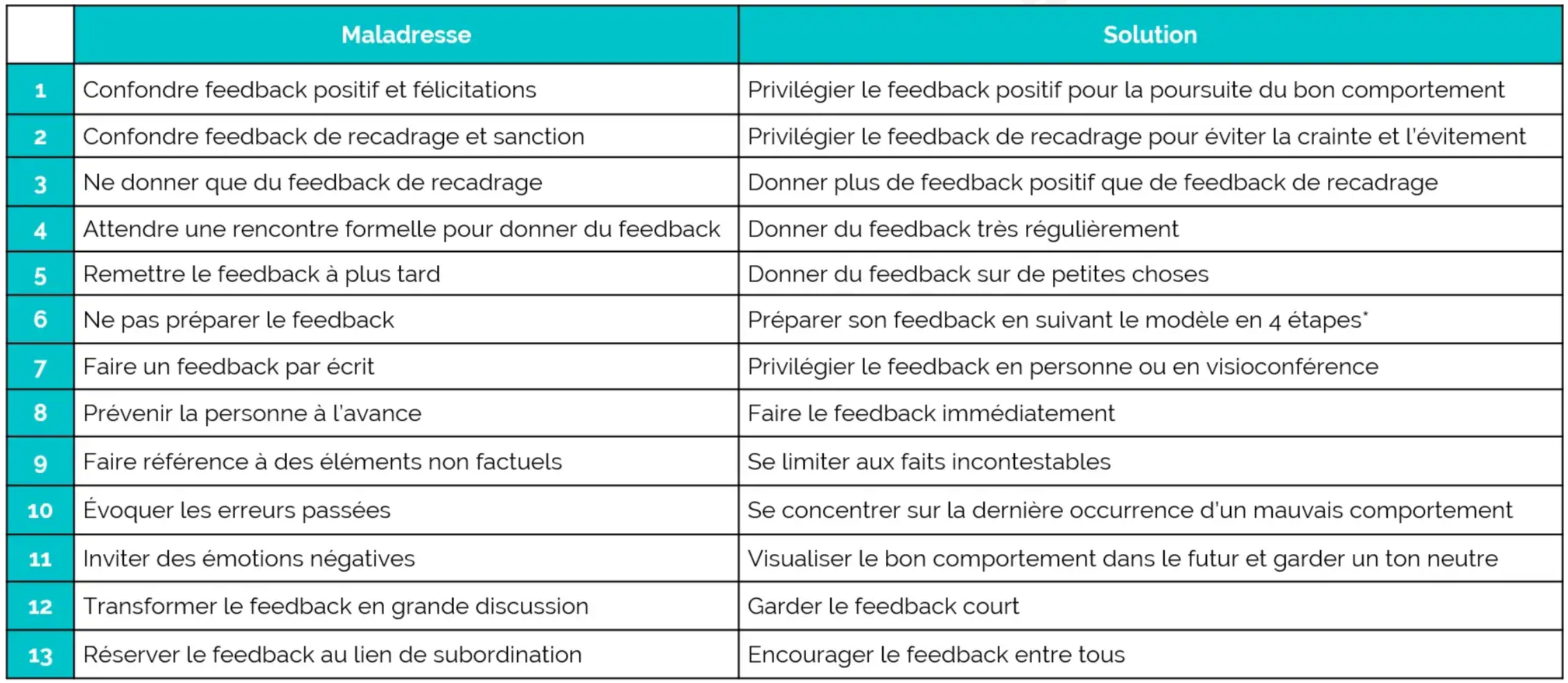
Here is a summary of the 13 mistakes covered in this article:
In the end, it is a genuine feedback culture that organisations should strive to build. No one should be afraid of giving or receiving feedback. But for that to happen, we need to dismantle our preconceptions about this exercise, and see feedback as a gift we offer to others — above all because we care about helping them improve.