
No one doubts the importance of investing in innovation to gain a competitive edge in the market. That said, have you ever considered the value of investing in intrapreneurship to enable innovation? And how to give the intrapreneurs on your teams the space they need?
This guide brings the essentials together: what intrapreneurship is, why to invest in it, how to develop an intrapreneurial culture, and a concrete example from the field.
What is intrapreneurship?
I don't know about you, but I first heard the term "intrapreneurship" at 23, in a university course — the complete opposite of entrepreneurship, which I was exposed to from childhood! So what did this new term, strangely similar to entrepreneurship save for two letters, actually mean?
In fact, there are many definitions. Very simply, it's a system that lets an employee act like an entrepreneur within an organization. Yes, but tell me more?
« A person who focuses on innovation and creativity and who has the ability to turn a dream or an idea into a profitable initiative, all while running it within the organization. » *
Investing in intrapreneurship therefore becomes a concrete lever towards innovation.
How is it different from entrepreneurship?
Here is a summary table laying out the most relevant distinctions:
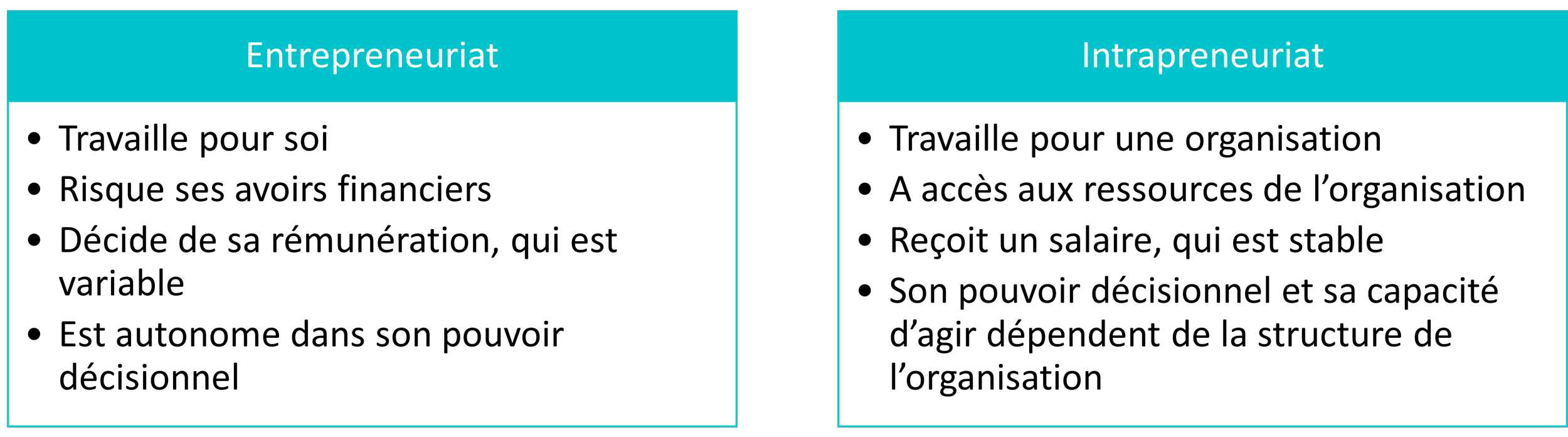
Essentially, the intrapreneur creates and develops an idea within the existing company and, above all, does not start their own company with their idea.
Why invest in intrapreneurship?
If I'm asking this question, it's because I see many advantages in managers investing in intrapreneurship.

Attract and retain talent
Personally, the managers I worked best with were those who gave me a certain freedom to develop my ideas within the organization. That freedom kept me engaged: I had the opportunity to have additional impact, to grow my skills and to learn from my experiences. Having been a manager myself for over five years, I led my teams in that same spirit, convinced that this approach contributed to retention. Used as part of a program, intrapreneurship becomes a concrete way to attract talent.
A lever for innovation
The intrapreneur focuses on innovation and has the ability to turn an idea into a profitable initiative. With a culture of intrapreneurship, your employees are encouraged to take risks and more inclined to think outside the box. This brings out new ideas and solutions that can result in innovative products and services — but also in improvements to internal processes and tools. To stay relevant and sustainable, an organization must continually explore and adapt. Which company no longer needs to innovate? None.
Break down silos
Finally, if you feel your teams are working in silos, know that intrapreneurship fosters collaboration. Intrapreneurial projects often mobilize several stakeholders, which strengthens relationships and the sharing of knowledge within the organization.
How to develop an intrapreneurial culture?
If all this sounds appealing, the next question is probably: how do you go about it? Several actions are possible to develop your teams' intrapreneurial mindset:
- Assessing the obstacles to intrapreneurship in your current structure
- Setting up an intrapreneurship program
- Training the management team to support intrapreneurial initiatives
Day to day, as a manager, you can also:
- Encourage autonomy, where failure is seen as an opportunity to learn (and not a reason to punish)
- Put feedback mechanisms in place for employees' projects and ideas
- Pair experienced intrapreneurs with those who want to develop their skills
- Set aside time — and even a budget — among the employee's priorities to work on their ideas
- Celebrate innovative ideas that have been successfully implemented
These behaviours echo the principles of shared governance: to go further, see how the building blocks of self-managed organizations fit together.
The Axial experience: taking ownership of change

On my very first day at IDEHŌ, my colleague Ariane gave me the opportunity to meet Agence Axial, a company specializing in eCommerce website design. Why meet them? Because we wanted to learn more about them, five years after their transition to a self-managed company.
For the occasion, so many questions ran through our minds: where are they five years later? What has changed? And above all, what are their needs today? It was the answer to that last question that caught my attention the most. Daniel, the owner, told us he would like to develop his team's intrapreneurial mindset. The answer surprised me: even though Axial implemented the principles of the self-managed company some time ago, employees don't fully take up the space they have to live out that autonomy.
Employees taking ownership of a change
Axial perfectly illustrates the importance of taking ownership of a change. The structure and processes can be the best on the market, yet it remains crucial that employees take ownership of them. This principle holds for any change involving human beings.
It happens through transforming and developing new behaviours within the team — exactly the practices described above. It is with this type of initiative that an intrapreneurial culture develops and intrapreneurial profiles emerge: people then feel comfortable taking risks and coming up with new ideas.
Whatever change you want to put in place, it is critical to take human beings into account. Axial's case shows it: investing in a structure and processes based on self-management does not guarantee that intrapreneurial behaviours will follow automatically. You need to identify the behaviours you want to see develop and set a strategy accordingly.
In summary
Investing in intrapreneurship gives you a concrete lever to innovate, attract talent and break down silos — provided you support the change and develop the right behaviours, not just the structure.
If you'd like to learn more about how to develop your teams' intrapreneurial behaviours, let's talk.
* Pinchot, G. III. (1985). Intrapreneuring: Why you don't have to leave the corporation to become an entrepreneur, New York: Harper and Row.