
You run a consulting firm and you're wondering whether to shift towards a self-managed company? You've already started that shift but are running into obstacles inherent to your operational reality?
In this article, we'll explore the main challenges consulting firms can face when undertaking such a profound transformation of their management model. We'll give recommendations and possible solutions drawn from our experience in the field.
First of all, note that your challenges will not be the same depending on the audience and the timing of your transformation.
In the ecosystem of a consulting firm, you always find the following three groups of actors:
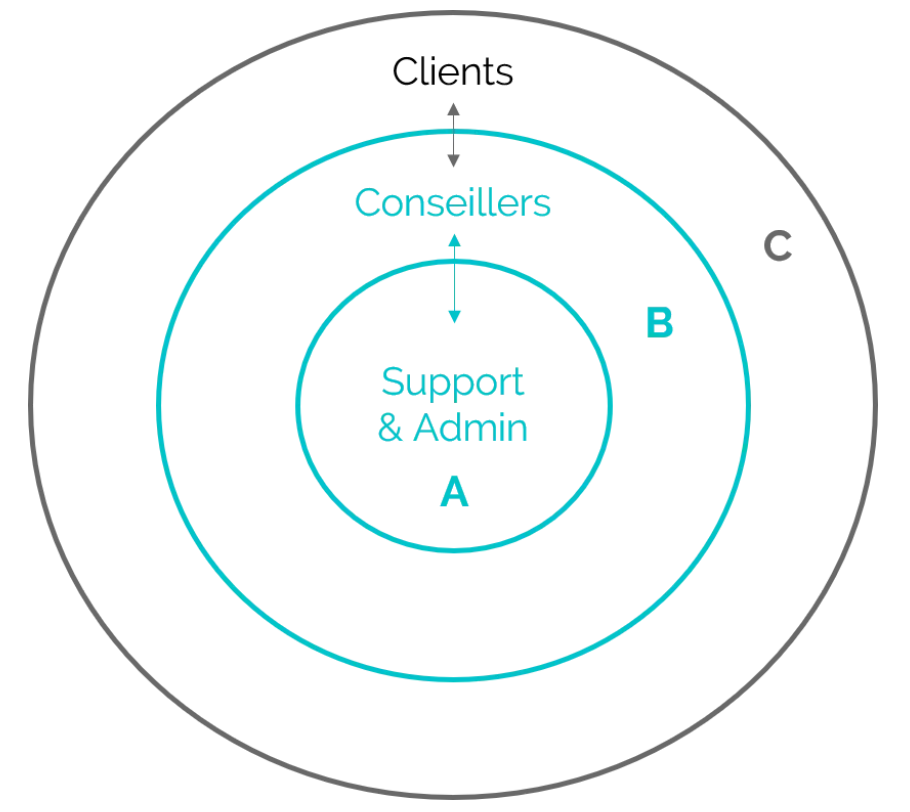
- Group A — Support & Administration: the people in an internal administrative or support role (HR, Finance, Marketing, IT, etc.)
- Group B — The consultants: the permanent employees who carry out engagements for their clients
- Group C — The clients
In a consulting firm, you can choose to implement self-management in 3 distinct ways:
- For group A only (the Support & Administration group)
- For groups A and B (the Support & Administration group and the Consultants group):
- a. At the same time
- b. Asynchronously
It is never a matter of converting our clients to the self-managed company model, but what must be understood is that by including the Consultants group in the model, complexity increases simply because they are in contact with the Clients group. The latter brings constraints over which we have no control. And this complexity is even greater if the consultants carry out their engagements directly at the client's site.
Depending on the audience chosen for the transition, let's examine the challenges you might encounter, and our recommendations for overcoming them.
1. Support & Administration only (Group A)
Let's start with the scenario where you choose to implement self-management only for the internal Support & Administration roles.
Advantages
- Inexpensive
If you implement self-management only at the level of internal support functions, the only costly resource will be the working time of the employees involved. But since they have no billable client role, there will be no additional monetary opportunity cost.
- Less complex
If you are about a hundred people in the company and the administrative and internal management staff represent around twenty people, that's 1/5 of the company to guide towards the self-managed company. Unsurprisingly, it's simpler to support 20 people through change than 100.
Drawbacks
- A two-speed company
If they are excluded from the initiative, consultants may feel left out of the company's core management and office life. This could create frustration and, by ricochet effect, an erosion of belonging and a form of disengagement.
- Under-using the model
By excluding the Consultants (group B) from the self-management machinery, you restrict the model's scope and therefore its potential benefits. For example, self-management proves very relevant for maximizing resource utilization when people are between engagements; but we'll come back to that later.
Recommendations
- Managing expectations
If your choice is to limit the application of self-management to the people in the Support & Administration group (group A), it is fundamental to explain the reasons for this choice transparently to the Consultants (group B).
- Minimal training for everyone
Even if they won't actively take part in the model, your Consultants are part of your organization and deserve to understand the new jargon and the new internal machinery. High-level training on the broad concepts of the chosen self-management approach is essential so that the consultants can decode the new reality of the administrative and support roles.
- Communication
Beyond this brief high-level training when the initiative launches, it's important to give the Consultants visibility as structural changes take place in the organization. When new circles or roles are created, or a new policy is put in place, they must be kept informed so as not to lose the thread. An internal newsletter can easily fulfil this function.
2. The whole company (groups A & B)
Let's now look at the challenges that transitioning an entire consulting firm to self-management can generate, regardless of the implementation pace chosen for each group.
Advantages
- Sense of belonging and company culture
By including the internal support roles and the consultants in the self-managed company machinery, no one feels left out — everyone moves in the same direction. The company culture evolves for everyone, with the new self-management jargon, the new meeting structure, and so on.
Challenges
- High cost
If we take the previous example, the cost of implementing self-management will be greater if you decide to bring on board all 100 employees and not just the 20 administration & support employees. The difference is not so much about the number of employees to train as about the opportunity cost of non-billable client hours.
- Two worlds, two realities
When they get involved in their internal projects on top of their client projects, the Consultants are constantly switching realities and hats. At the client's, they work according to the client's methodology, with the title they've been assigned, in a classic hierarchy. When they work on internal projects, they don't hold a title, but occupy one or more roles. They have to shift mindset to adopt the reflexes of self-management. Real mental gymnastics to have the right attitude at all times. For this reason, it sometimes takes longer for Consultants to absorb the concepts of self-management: a large part of their brain has to keep operating in the classic hierarchy mode since they are at the service of their clients. This is even more pronounced if the consultants carry out engagements directly at the client's site and are part of a project team.
- Billable schedule vs. internal projects
In our experience, this is the most critical challenge. If your consultants work at their clients on full-time fixed-term contracts, how do you reconcile that with active participation in the organization's internal projects? Is it realistic to think that a consultant who bills 100% of their working time at the client can also invest internally in parallel? If you promise all employees that self-management is an opportunity to have an impact on the organization, but the target client assignment time remains 100%, you risk running into a great deal of frustration…
Recommendation
- A generous budget
Plan for a substantial implementation budget, factoring in the opportunity cost of training billable consultants.
Jonas Vonlanthen, Partner at Liip in Switzerland, knows this challenge well: "The last Holacracy training we ran at Liip was for 50 people over 4 days, 60% of whom were normally on projects. So that's 120 person-days of project work lost, plus the training costs. It's a big investment, that's true. On the other hand, we quickly saw in the following months that people had understood the mechanics and that everything moved faster. Not to mention that the self-managed structure saves the costs of a classic hierarchical structure (notably by eliminating the high salaries of middle management)."
- Coaching
To address the consultants' hat-switching challenge between internal and external work, it's important to offer them coaching to help them absorb the concepts of self-management faster and to spot when they fall back into old patterns that no longer have a place in the new internal reality. Project management at the client differs from internal project management.
You could also help the consultants align their schedule with the client's reality.
- Managing expectations
There is no absolute rule on the acceptable amount of time to devote to internal projects. Anything is acceptable as long as managing expectations is given particular attention.
If your wish is to allow all consultants to get involved in the self-managed organization and internal projects, one possibility is to make only 80 or 90% of each consultant's time available to clients. This requires a sacrifice in sales which, for some companies, can prove worthwhile.
If for financial and risk-management reasons it is impossible to promise all consultants time for internal projects, then don't promise them the moon. Good expectation management would be, for example, to say: billable time always remains the priority; when you are not 100% busy at a client (part-time engagement or between engagements), then you are invited to take on internal roles, which you must drop as soon as your billable time no longer allows you to assume them. This way, you take advantage of the flexibility the self-management model brings to reallocate resources quickly, without putting your profitability at risk. Not only should this mechanism be clarified as early as possible, but it should also appear in the form of clear strategies / policies in the self-management model.
Let's now look at the impact of the timing of the transition.
a. Support, administration and consultants at the same time
You like the idea of letting all employees experience the self-managed company? Let's see what happens if all employees are initiated at the same time.
Advantages
- Momentum
By bringing everyone on board from the start, you can create real collective enthusiasm at launch. This boosts the sense of belonging and lets everyone start learning the new concepts at the same time.
- Economies of scale
If you call on an external trainer or coach to support you through the transition, you'll only have to pay the support fees once for the whole group.
Drawbacks
- A very costly launch
The launch will probably represent a fairly substantial budget, because on top of the training cost you'll add the opportunity cost of lost revenue from the consultants' billable time. Finances can be affected in the short term.
- Putting all your eggs in one basket
Should the transition prove more complex than expected, the negative repercussions of a possible failure could impact the entire company.
Recommendations
- Proof of concept
If you want to bring the whole company on board at the same time for this great adventure, don't hesitate to run an internal proof of concept before launching, to validate the model's viability in the context of your business reality. Every company is unique and every culture is unique!
- Accepting to slow down to accelerate better afterwards
Keep in mind that the slowdown in activity will be temporary and necessary, to then let you re-accelerate thanks to mastery and application of the self-management concepts.
b. Support, administration and consultants, asynchronously
Finally, you could choose to bring on board first the employees of the Support & Administration group (group A) and then the Consultants (group B) in a second phase.
Advantages
- Financial impact spread over time
You'll absorb the financial impact of the implementation over several months instead of spending it all at launch.
- An iterative process
By starting the implementation with a first group, you give yourself the possibility of testing the approach on a limited number of people and gaining maturity on the model before extending it to the rest of the company. You demonstrate agility and have a little more freedom of movement.
Drawbacks
- Difference in levels
Imagine you decide to bring on board the Support & Administration group today and the Consultants group in 3 months. When the consultants are just starting their training, the other employees will already have acquired good reflexes and a certain autonomy. This can create imbalances in meetings that mix the two groups, generating weariness for the Support & Administration people, or stress for the Consultants.
- A two-speed company
Even for a few months, having a two-speed company can create a gap and generate disengagement.
Recommendations
- Planning
If you opt for a two-phase implementation, it's important to have a date set in advance for including the second group, so that its members can picture themselves in the new reality without feeling left out.
- Communication
Throughout the first implementation phase, don't skimp on internal communication to give group B visibility into what's happening for group A, which is already operating in self-management. This will also let you strengthen group B's desire to discover this way of working in turn.
- Ambassadors
Finally, if you're going to implement self-management in two phases, you could identify the people in the first group who will become the ambassadors of the implementation's success in the second group. A worthwhile strategy from a change-management standpoint. This is the approach Liip chose: "Before launching, we wanted to test the model for 6 months. We trained 10% of employees, choosing influential people who had been in the company long enough. We chose the strong personalities, those who always have something to say — including people who were not in favour of the initiative. The goal was for these people to experience the self-management processes for 6 months and spread their knowledge around them in the company. At the end of the test period, we took stock, and since a large majority was in favour of continuing the initiative, we invested to train more people." Jonas Vonlanthen, Partner, Liip.
In summary
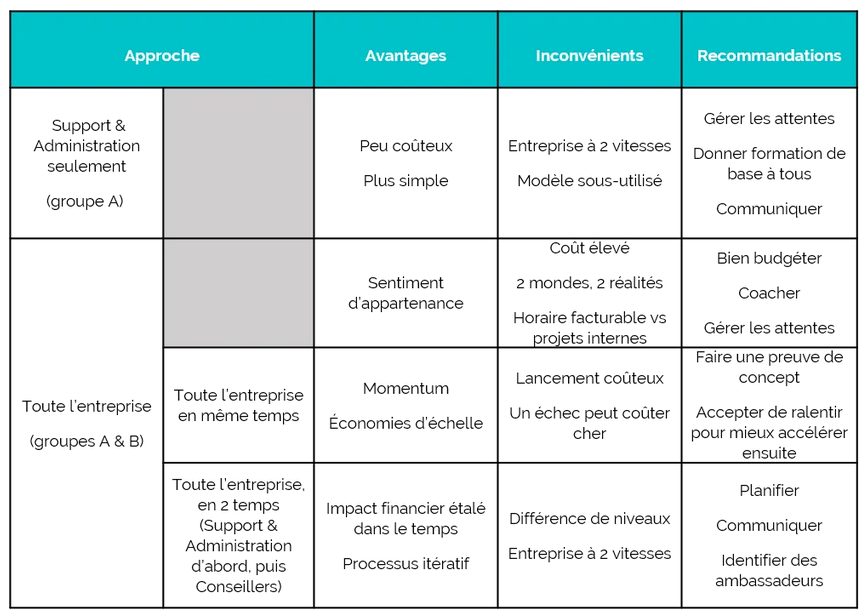
In the end, all 3 implementation strategies are entirely feasible. Each has its own challenges and complexities, but no obstacle is insurmountable. Here is a summary table of the points covered in the article:
Before throwing itself headlong into self-management, every consulting firm should ask which strategy to favour based on the deep motivations behind its transformation — the Why.
If your primary goal is to give employees autonomy and strengthen the sense of belonging and retention, you should consider bringing everyone on board. If your goal is to free managers from management tasks and speed up internal decision-making, you might choose to include only the internal group of Admin & Support roles.
But whatever strategy you choose, the important thing is to:
- Manage expectations
- Plan
- Train
- Communicate
- Support
Happy implementing!